Blog
AI Appointment Setter for Small Business in 2026: What It Costs, How It Books, and When to Get One
By Tech Instance · · 12 min read
Direct answer
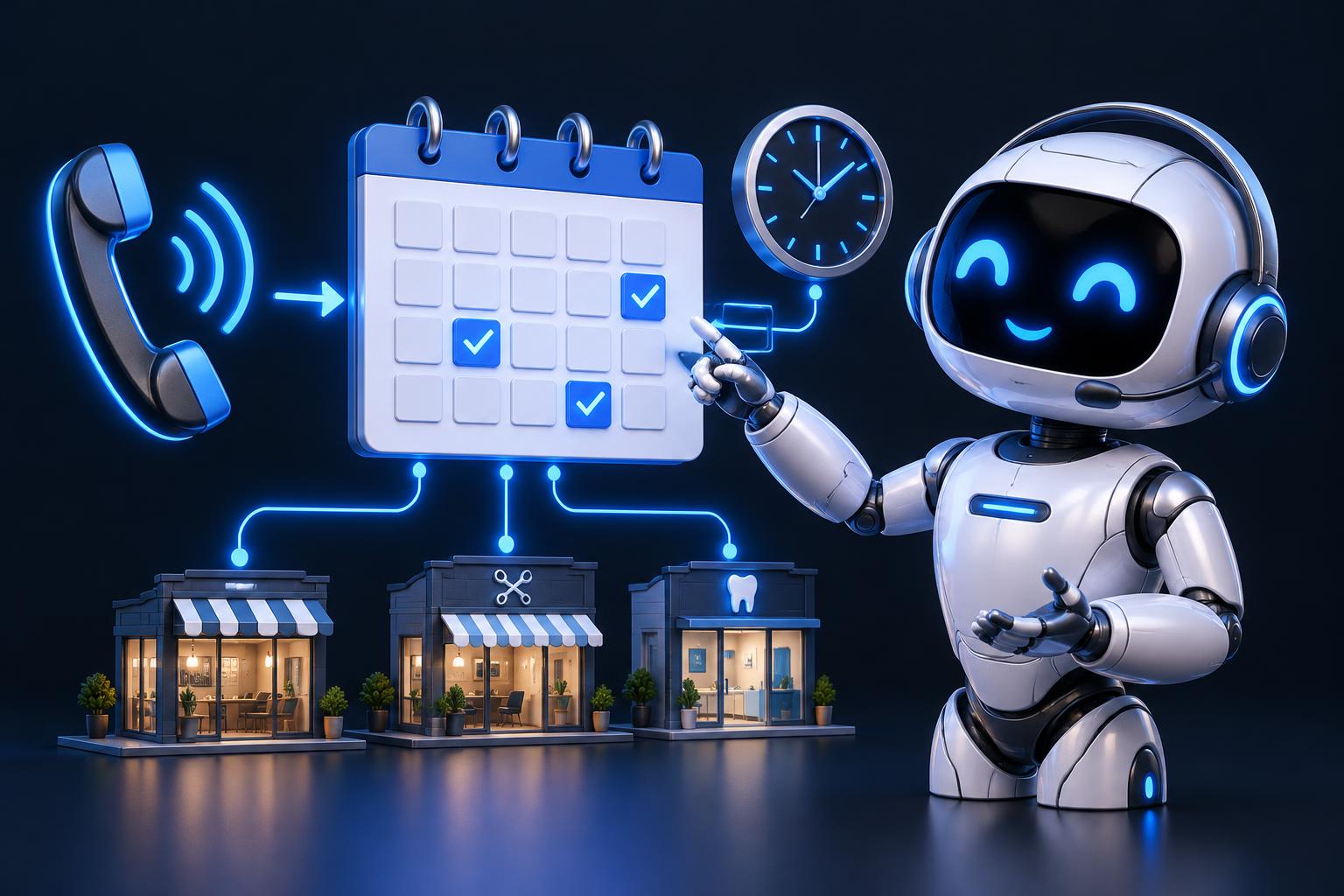
An AI appointment setter answers your business phone around the clock, talks to the caller like a trained receptionist, and books the appointment straight into your calendar without a human touching the phone. For a US small business in 2026, it costs $49 to $499 a month on a turnkey plan, or $0.07 to $0.33 per minute of talk time on a platform you configure yourself. It answers on the first ring at 8 pm and at 2 am, checks your real availability, collects the caller's details, sends a confirmation, and follows up with a reminder that cuts no-shows. It does not replace your front desk. It covers the calls your front desk never gets to: the ones after hours, the ones during the rush, and the ones nobody has time to call back. If missed calls and empty calendar slots are a known problem in your business, this is usually the cheapest place to fix it.
October 2026: why booking by AI stopped being a demo and became normal
First, the platforms got provably reliable. In October 2026, an independent open benchmark ran the same AI voice agent across nine configurations and 82 caller scenarios. PolyAI passed 87.8 percent of the scenarios, Retell came second at 75.6 percent with a perfect interruption score, and ElevenLabs answered in 1.27 seconds on average with the best rated voice quality. That matters for booking, because a missed booking question or a botched interruption is exactly where appointment callers hang up. Booking flows are now being tested the way software gets tested, and the results are published.
Second, the money moved. A Gartner survey of 199 service leaders found AI spending up 38 percent in 2026 while overall service budgets grew just 2 percent. The global AI voice agent market is now estimated between $3 billion and $5 billion in 2026, depending on whose definition you use. Vapi reported more than 1 billion calls and 2.7 million agents on its platform in May 2026, and Bland handles more than 3.5 million calls a week. Appointment booking is the inbound-heavy job that made up the larger half of that revenue. This is not a lab experiment. It is where small business phone traffic is actually going.
Third, the rules got clearer in the US, and that is good news for appointment setters specifically. The FCC's September 2026 TCPA changes tightened the opt-out rules around automated and AI generated outbound calls, which means cold outreach by AI voice is now firmly in the "get legal advice first" category. Inbound appointment booking, on the other hand, stays on safe ground: a caller dials your number, the agent answers, books the visit, and everyone is happy. The businesses winning with AI appointment setters in late 2026 are mostly playing the inbound and confirmation game, not the cold calling game.
What an AI appointment setter actually does
An AI appointment setter is a voice AI agent wired to your calendar. When a customer calls, it answers immediately, in a natural voice, and holds a real conversation. The six jobs it usually covers:
It answers every call on the first ring, nights and weekends included. It answers routine questions from your own content: hours, location, services, pricing basics. It checks live calendar availability and books the appointment on the call, naming the time back to the caller. It collects contact details and writes them into your CRM or booking system. It sends an instant confirmation by text and an appointment reminder the day before, which is where the no-show reduction comes from. And it routes anything complicated, sensitive, or urgent to a person, warm or cold, instead of guessing.
What it should never do is invent availability, quote a price you did not give it, or keep a frustrated caller circling. A well built one hands over cleanly and tells the caller it does not know. Those failure modes are configuration problems, not technology problems, and the October 2026 benchmark results above are essentially a scoreboard for how well the platforms handle interruptions and edge cases.
What it costs a US small business in 2026
Appointment setting pricing comes in four routes, and the right one depends on call volume and who does the setup.
Turnkey AI answering platforms run $49 to $499 a month. Rosie AI sits at $49 to $99 for solo operators and front desks, Goodcall at $59 to $199 for local business missed-call recovery, My AI Front Desk at $65 to $199 for inbound service businesses, and Brilo.ai at $149 to $499 for multi-location operations that need CRM sync. These are flat subscriptions with included minutes or calls and overage charges beyond that. They launch fast because they come with booking templates for common trades.
Per-minute developer platforms run $0.07 to $0.33 all in per minute. Retell's published 2026 teardown documents $0.07 to $0.31 a minute once you add LLM, voice, transcription, and telephony. Vapi charges $0.05 a minute for hosting with model and voice costs passed through at cost. AssemblyAI and Deepgram each price their voice agent APIs at a flat $4.50 an hour, which is $0.075 a minute, billed per second. This route is cheaper at low volume and completely flexible, but you or your developer configure the call flows, prompts, and calendar wiring.
Managed appointment setter services run $500 to $2,500 a month plus platform usage. You get the build, the calendar integration, the CRM wiring, call transcript reviews, and monthly tuning. This is the route for businesses that want booking handled as an outcome, not a platform.
Custom builds run $5,000 to $30,000 for a single location workflow, and $75,000 and up for multi-location or regulated operations. You do not need this for standard booking. You need it when booking logic is genuinely unusual: insurance eligibility checks, complex multi-staff rules across locations, or regulated intake.
For comparison, the human routes: a traditional telephone answering service typically costs $300 to $500 a month, and a human virtual receptionist service for a small business runs about $150 to $800 a month depending on call volume. A full-time receptionist in the US costs $28,000 to $42,000 a year before benefits. The AI option is not the cheapest line on the page. It is the only one that answers at 2 am.
Cost table
| Route | Typical cost | What you get | Best for |
|---|---|---|---|
| Turnkey AI answering platform | $49 to $499 per month | Flat subscription, booking templates, included minutes, overage beyond | Single location shops that want fast setup |
| Per-minute platform, self built | $0.07 to $0.33 per minute all in | Full control, lowest cost at low volume, you configure everything | Technical owners or their developers |
| Managed appointment setter service | $500 to $2,500 per month plus usage | Setup, calendar and CRM wiring, transcript review, monthly tuning | Owners who want booking as an outcome |
| Custom build | $5,000 to $30,000 simple, $75,000 and up complex | Bespoke booking logic, long build, ongoing maintenance | Multi-location or regulated operations |
| Human virtual receptionist | $150 to $800 per month | A person answering, business hours or extended | High judgment calls, in person culture |
AI appointment setter vs the alternatives
| Option | Coverage | Best job | Weakness |
|---|---|---|---|
| AI appointment setter | 24 hours, phone | Inbound booking, after hours calls, reminders | Needs call flow design and calendar wiring |
| Human receptionist | Business hours | Judgment, negotiation, in person service | Highest cost, no night cover without shifts |
| Traditional answering service | Often 24 hours | Taking messages | Impersonal, rarely books into your calendar |
| Online scheduler (Calendly style) | 24 hours, web | Bookings from web visitors | Useless for callers who pick up the phone |
| AI chatbot | 24 hours, text | Website and message bookings | Cannot take a phone call |
The scheduler row is the one people miss. A web booking link handles the customer who already found your website. It does nothing for the customer who Googled you, tapped call, and reached a ringing phone at 7:40 pm. Those two groups are different people, and most small businesses lose the second group entirely.
The numbers that make the case
The 2026 missed call data is blunt. Industry benchmarks from Invoca's 2026 missed call study put the average value of an inbound service call at $138 to $420 depending on vertical. Small businesses typically miss 23 to 38 percent of inbound calls during business hours and 100 percent after hours. A separate 2026 study found small and mid sized businesses miss roughly 25 to 60 percent of inbound calls. And 78 percent of customers buy from the business that responds first, while 67 percent of callers will not leave a voicemail.
The worked example keeps it concrete. Take a dental clinic that gets 800 calls a month and misses 30 percent of them. That is 240 missed calls. If an AI appointment setter answers those calls and converts 40 percent into booked appointments, that is 96 extra appointments a month. At a $400 average patient value, that is $38,400 in recovered revenue a month against a $99 to $299 a month platform cost. You do not need every assumption to be exact. Even at half the conversion, the math is not close.
The reminder loop adds a second return. Outbound AI confirmation calls 24 hours before the appointment reduce no-shows by 18 to 31 percent in dental, salon, HVAC, and home services, per multiple vendor case studies. One 4 location HVAC shop in the Phoenix metro documented the full stack: 1,850 inbound calls a month, 31 percent missed, deployed a custom booking flow at $1,420 a month all in, and after 60 days had 188 of those previously missed calls converted into booked service tickets averaging $385. That is roughly $70,000 a month in recovered bookings. Measure on recovered appointments, not on minutes.
The US rules that actually apply
Three things to get right before you switch one on. First, the AI disclosure question. A growing number of US states expect callers to be told they are speaking to an AI, and the EU's Article 50 rule in effect since August 2026 sets the global expectation that disclosure happens at the start of the conversation. Build the disclosure into the opening line. It does not hurt conversion the way people fear, and it keeps you ahead of every state rule.
Second, inbound vs outbound. An AI appointment setter that answers your incoming calls and books visits is on the lowest risk ground in US telecom law. An AI agent that dials out, including reminder and confirmation calls, steps into TCPA territory, and the FCC's September 2026 opt-out changes made the compliance bar for automated outbound calls stricter. Appointment reminders to existing customers are generally the safest outbound use, but get your consent language and opt-out handling checked. Never use an AI voice agent for cold outbound.
Third, data. The agent collects names, phone numbers, and appointment details, so it needs a written data policy: where call recordings live, how long you keep them, and who can access them. If you are in healthcare, the voice platform needs a signed BAA. Ask for this in writing before you sign, not after.
How to start in five steps
Pull your last three months of call data and count total calls, missed calls, and average job value. That tells you whether the math works before you spend anything.
Pick the route from the cost table. Most single location US small businesses land on a turnkey platform in the $49 to $299 range. Choose the platform for its calendar integration with your actual booking tool, not for the voice demo.
Write the booking rules before the prompts. Staff availability, service durations, buffer times, blackout rules, and the exact questions you need answered before a booking counts. The agent is only as good as the rules you give it.
Test with real callers, not just your team. Run a week of parallel operation where the agent handles after hours calls and you review every transcript. Fix the failure points: the unusual request, the heavy accent, the caller who interrupts. This is the week that decides whether it books or burns.
Measure booked appointments per week, show rate, and caller satisfaction for 60 days. Compare against the pre-launch baseline from step one. Keep the transcript reviews monthly after that, because caller behavior drifts and prompts need tuning.
The wrong buy, and how to avoid it
The wrong buy is picking the cheapest flat-rate tool, pointing it at your main number with a five minute setup, and assuming the calendar will sort itself out. The three most common failures we see: a calendar integration that books double, no human fallback so frustrated callers get trapped in a loop, and zero transcript review so a broken booking flow runs for weeks unnoticed. Any of the three makes the agent a cost instead of a revenue line.
The fix is the same five step process above, run honestly. The technology is proven, the October 2026 benchmarks show it, and the vendors publish their all in rates. The difference between a $70,000 a month booking engine and an expensive voicemail is the week of testing and the monthly transcript review.
Frequently Asked Questions
How much does an AI appointment setter cost per month?
A turnkey plan runs $49 to $499 a month with included minutes and overage beyond that. A platform build you configure yourself costs $0.07 to $0.33 per minute all in. A managed service runs $500 to $2,500 a month plus usage. Most single location small businesses land in the $49 to $299 turnkey range.
Will callers know they are talking to an AI?
You should tell them, in the opening line. Several US states expect AI disclosure on calls, and the EU's Article 50 rule requires it at the start of the conversation. Disclosure does not hurt booking rates the way owners fear. Callers care that the appointment got booked correctly, not who booked it.
Can it handle cancellations and reschedules?
Yes, if your booking rules define them. Cancellation windows, reschedule limits, and waitlist offers are all standard configuration on turnkey platforms. The key is writing the rules before launch: the agent books and moves appointments exactly the way you tell it to, and nothing more.
What happens when a caller asks something it cannot handle?
It transfers to a person, warm or cold, based on rules you set: urgent requests, angry callers, or specific keywords. A human fallback path should be part of every deployment. The October 2026 independent benchmark scored platforms specifically on interruption handling, because this is where weak agents fail.
Does it replace my front desk staff?
No. It covers the calls your front desk misses: after hours, during rushes, and the callbacks nobody has time for. Your staff keeps the judgment heavy work, the in person experience, and the complex cases. Most businesses keep the same team and let the agent absorb the growth.
Is outbound AI appointment setting legal in the US?
Inbound booking is low risk. Outbound AI calls, including confirmation and reminder calls, fall under the TCPA, and the FCC's September 2026 opt-out changes raised the compliance bar. Appointment reminders to existing customers with proper consent and opt-out handling are generally the safest outbound use. Cold outbound by AI voice is a legal risk. Get advice before any outbound dialing.
Book a Strategy Call
Ready to Build Your Growth System?
Talk with Tech Instance about AI automation, CRM, web development, and SEO for your business.